Safety Investigation Report 2018:1 Factual Information/1.9/1.9.5 Satcom/2
SAFETY INVESTIGATION REPORT MH370 (9M-MRO)
1.9.5 Satellite Communications
2) Satellite Communications Ground Station Logs of the Event - Introduction
Throughout the flight of MH370, the aircraft communicated through the Inmarsat Indian Ocean Region (IOR) I-3 Satellite and the GES in Perth, Australia.
Figure 1.9M (below) shows the Inmarsat I-3 IOR Satellite Coverage Map. The blue lines represent the elevation angle to the IOR satellite for a SATCOM unit on the ground or in the air. Due to the satellite inclination, the elevation angles are approximate.
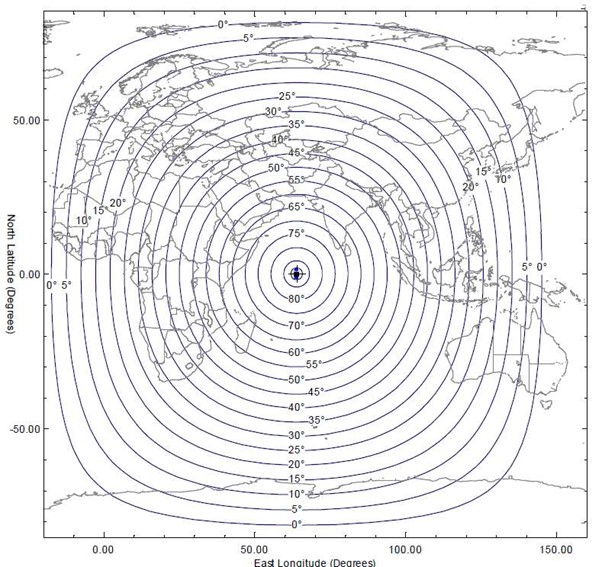
Figure 1.9M - Inmarsat I-3 IOR Satellite Coverage Map
Source:
Safety Investigation Report MH370/01/2018
MH370 departed KLIA at 1642 UTC [0042 MYT, 08 March 2014]. At 1707 UTC, the SATCOM system was used to send a standard ACARS report, normally sent every 30 minutes. The message also indicated the remaining fuel on-board.
The ACARS reports expected at 1737 UTC and 1807 UTC were not received. The next SATCOM communication was a log-on request from the aircraft at 1825 UTC. From that point until 0011 UTC, SATCOM transmissions indicate that the link was available, although not used for any voice, ACARS or other data services apart from two unanswered ground-to-air telephone calls. At 0019 UTC, the AES initiated another log-on request. The log-on acknowledge was the last transmission from the SATCOM.
The SATCOM link was available for most of the flight, excluding a period of between 22 and 78 minutes leading up to 1825 UTC, 07 March and a period of less than 8 minutes leading up to 0019 UTC, 08 March 2014. The absence of any aircraft-initiated handshakes, and on-going success of ground-initiated handshakes, indicates that power to the SATCOM was maintained other than the two periods stated above.
Data from the last seven ‘handshakes’ were used to help establish the most probable location of the aircraft. Initially only the first six of these ‘handshakes’ were considered to be complete. The seventh and last ‘handshake’ that was automatically initiated by the aircraft, was originally assessed as a partial ‘handshake’. Subsequent analysis confirmed the 7th handshake could be used to help determine the most probable flight path. Two unanswered ground-to-air telephone calls had the effect of resetting the activity log and hence increased the period between the ground initiated ‘handshakes’. The significant times used to identify the most probable final location of the aircraft are tabulated in Table 1.9B below. Details of the event’s SATCOM ground station logs are provided in Section 1.9.5 para. 3) and 4) (below).
| SATCOM TRANSMISSIONS | TIME | ||
|---|---|---|---|
| UTC | MYT* | ||
| 1. | Aircraft departed KLIA | 1642 | 0042 |
| 2. | Last ACARS transmission | 1707 | 0107 |
| 3. | 1st handshake - log-on initiated by the aircraft | 1825 | 0225 |
| 4. | Unanswered ground-to-air telephone call | 1839 | 0239 |
| 5. | 2nd handshake initiated by ground station | 1941 | 0341 |
| 6. | 3rd handshake initiated by ground station | 2041 | 0441 |
| 7. | 4th handshake initiated by ground station | 2141 | 0541 |
| 8. | 5th handshake initiated by ground station | 2241 | 0641 |
| 9. | Unanswered ground-to-air telephone call | 2313 | 0713 |
| 10. | 6th handshake initiated by ground station | 0011* | 0811 |
| 11. | 7th handshake - log-on initiated by the aircraft | 0019* | 0819 |
| 12. | Aircraft did not respond to ‘handshake’ from Satellite Earth Ground Station | 0115* | 0915 |
| *08 March 2014 | |||
Table 1.9B - SATCOM ‘Handshakes’