Safety Investigation Report 2018:1 Factual Information/1.9/1.9.4 ACARS/Intro
SAFETY INVESTIGATION REPORT MH370 (9M-MRO)
The Aircraft Communications Addressing and Reporting System (ACARS) is a digital data-link system that manages flight plan and maintenance data between the aircraft and the Ground Service Provider (GSP) by using radio i.e. VHF or satellite communications (SATCOM) as shown in Figure 1.9B (below).
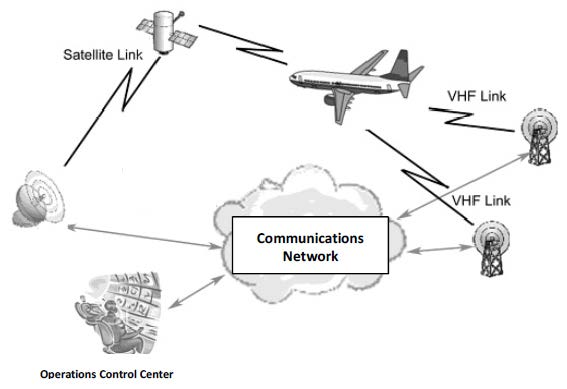
Figure 1.9B - ACARS System
Source:
Safety Investigation Report MH370/01/2018
ACARS provides message communication between aircraft and its base (ground). The following messages are transmitted:
- Out of the gate, Off the ground, On the ground, and Into the gate (OOOI) events:
- Out of the gate event: Departure from the gate with all doors closed and parking brake released;
- Off the ground event: Take-off with the nose gear squat switch extended;
- On the ground event: Touch down with the nose gear squat switch compressed; and
- Into the gate event: Parked at the gate with the parking brake set and the door open.
- Flight plans: ACARS interfaces with Flight Management Systems (FMS) acting as the communication system for flight plans to be sent from the ground to the FMS. This enables the aircraft to update the FMS while in flight and allows the flight crew to evaluate the alternative flight plans including the status of connecting flights.
- Weather information: ACARS interfaces with FMS, acting as the communication system for weather information to be sent from the ground to the FMS. This enables the aircraft to update the FMS while in flight and allows the flight crew to evaluate new weather conditions.
- Equipment health: ACARS is used to send information from the aircraft to ground stations about the conditions of various aircraft systems and sensors in real-time. Maintenance faults and abnormal events are also transmitted to ground stations along with detailed messages, which are used by MAS for monitoring equipment health, and to better plan the repair and maintenance activities.
- Aircraft positions which provide latitude and longitude, altitude, speed, total air temperature, total remaining fuel, wind direction and speed and heading.
- Engine performance data which provide engine data during take-off, climb, cruise and approach.
ACARS interfaces with the Multifunction Display (MFD) in the cockpit, which flight crew can use to send and receive technical messages and reports to or from ground stations, such as a request for weather information or clearances or the status of connecting flights. The response from the ground station is received on the aircraft via ACARS as well. The ACARS Manager page in the Communications main menu on the selected Multifunction Display (MFD) is used for this purpose. The COMM display switch, located on the display select panel, displays the communications main menu on the selected MFD. The ACARS Manager page allows the flight crew to independently select/deselect VHF or SATCOM transmission of data.
The ACARS communicates through either the VHF or the SATCOM systems. The ACARS datalink connects to the Satellite Data Unit (SDU) of the SATCOM system and the Center and Right VHF Communication Transceivers of the VHF systems. The Center VHF exchanges data with the ACARS modem in the Communications Core Processor Module (CPM/Comm) of the Left AIMS cabinet. The right VHF exchanges data with the ACARS modem in the CPM/Comm of the Right AIMS cabinet. The ACARS does not interface with the Left VHF Transceiver.
For the ACARS operation the Data Communication Management Function (DCMF) of the AIMS uses the voice/data select to set the VHF Communication Transceiver to the data signal mode. At power-up, the DCMF sets the Center VHF Communication Transceiver to the data signal mode. If the Center VHF Communication Transceiver fails, or voice is selected manually by the flight crew, the DCMF selects SATCOM for data transmissions. If SATCOM fails, the DCMF selects the Right VHF Communication Transceiver for data transmissions. The Left VHF Communication Transceiver is voice only. On the event flight, as instructed by Ground Operations via text message shown on the MFD (shown as ‘Switch VHF3 to Voice’), the flight crew would have selected voice on the Center VHF resulting in SATCOM being used for the data transmissions. Refer to page 1 of Appendix 1.9A – ACARS Traffic Log. The use of SATCOM for the ACARS transmissions is evident in the SATCOM Ground Station Logs [refer to Section 1.9.5, para. 4)]. This switching from VHF to SATCOM for the data transmissions is normal practice in MAS for commercial reasons.
In the event that the aircraft ACARS unit has been silent for longer than a pre-set time interval, the ground station can ping the aircraft (directly or via satellite). A ping response indicates a healthy ACARS communication. This ping is different from the Satellite ping or handshake.
Pre-set time interval for MAS B777 is 30 minutes. When the aircraft ACARS is silent for more than 30 minutes, MAS Operation Control Centre (OCC) is required to send a text message via ACARS to the cockpit or to call the cockpit via SATCOM.